
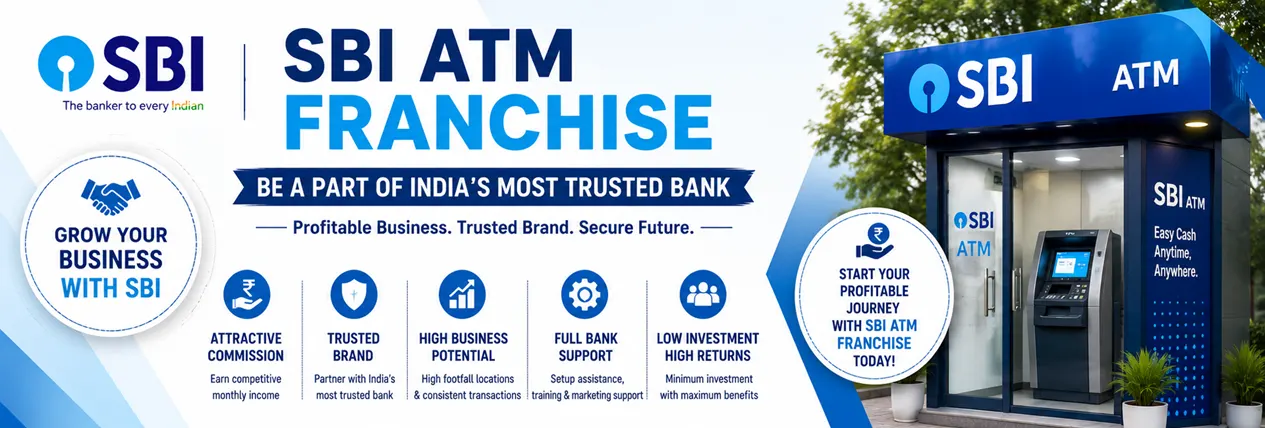
Indian banks are always innovating themselves because of the increasing demand for convenient money transactions and many other banking operations. One of the best examples of innovations is the SBI ATM Franchise - one of the best ways for entrepreneurs to participate in the process of revolution in the financial sector in India. The guide provides you with all the information related to opening SBI ATM franchises, investments in SBI ATM franchises, applications, and other things that will assist you in starting the SBI ATM franchise business or even dealership.
Being the biggest public bank in India, SBI provides you with an opportunity to open a lucrative franchise of ATMs with professional assistance and financial stability. If you are thinking about opening an SBI ATM franchise or even a dealership, you should pay attention to the price of an SBI ATM franchise and other aspects concerning it.
SBI’s excellent reputation and assured clientele has attracted many entrepreneurs who are searching for a lucrative bank services franchise that will make money without hassles.
Authority and Trust
The SBI ATM franchise business leverages the unmatched goodwill of SBI, being the biggest and most trusted bank in India.
Guaranteed Customer Base
The SBI ATM franchise business utilizes the huge customer base of SBI for finding suitable spots for ATM transactions.
Profitable Business Model
The SBI ATM franchise business brings in steady income through fees and finance service provision.
Simplified Management
SBI ATM franchise business works on the concept of simplified management, unlike other traditional banking processes.
Technical Support Services
Technical support is provided by SBI in the form of regular maintenance and security of the ATM business.
Potential for Expansion
One can start with an SBI ATM franchise and gradually move towards other locations in the ATM business.
It becomes necessary to have an idea about the entire investment made by SBI for the ATMs, construction of infrastructure, setting up process, training and working capital.

SBI ATM Franchise Plans Study different cost plans and investment schemes of SBI ATM franchise plans and select the one that suits your requirements.
Find an Appropriate Location Find out locations having maximum crowd, including commercial locations, residential locations, and other business locations for setting up your SBI ATM.
Financial Documentation Collect financial documents like bank statements, income tax papers, and other financial papers for your SBI ATM franchise plan.
Apply For SBI ATM Franchise Apply for an SBI ATM franchise through an online application form and give information related to your location and business.
Undergo the Evaluation Process The SBI franchisee team evaluates your financial capability, location, and business plans.
Setting Up & Training If approved, you'll typically sign a formal agreement and receive training on ATM operation, maintenance, and compliance requirements.
Start your SBI ATM franchise business after you are eligible, locate the correct site and contact the SBI franchise holders.
Ensure that you are eligible for an SBI ATM franchise for a bank service center from a finance and operations point of view.
Search for locations that are suitable for setting up an SBI ATM franchise, such as retail outlets, shopping complexes, business zones, and residential zones.
Calculate the finances associated with your SBI ATM franchise, including the cost of an SBI ATM franchise and its revenue.
Discuss with current SBI ATM franchise holders to get to know about their operations and income.
Get official SBI ATM franchise contact information from the SBI Corporate office.
Apply for an SBI ATM franchise from the official SBI website with full financial details.